ODE Solver
Solve ordinary differential equations with AI-assisted equation setup and interactive graphs. ODE Solver is a free online tool for solving first and second-order ordinary differential equations using the Runge-Kutta 4th order numerical method, with no signup required.
Core Capabilities
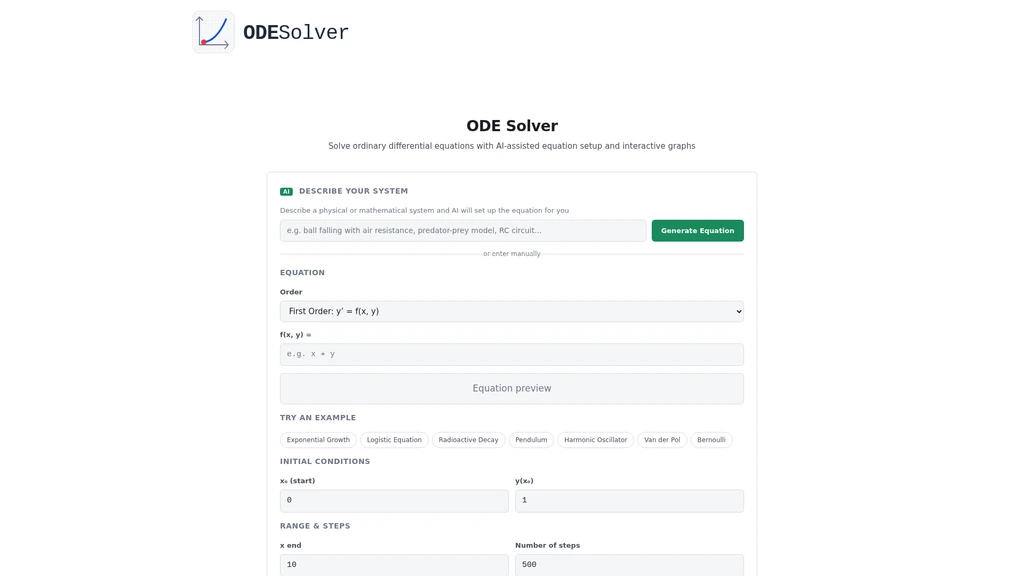
ODE Solver supports two distinct workflows for defining equations to fit different user preferences and use cases.
The AI-powered setup feature generates complete ODE equations from plain English descriptions of physical, biological, or engineering systems. Users can describe a system such as "spring with damping" or "population with carrying capacity", and the tool will automatically generate the corresponding differential equation, select the correct order, and suggest appropriate initial conditions. All generated parameters can be reviewed and adjusted manually before running a solution.
For users who prefer full control, the tool supports manual entry of ODE equations using x and y as standard variables. For second-order equations, users use dy to represent the first derivative of y.
The tool supports all standard arithmetic operations including +, -, *, /, and ^ for power, plus common mathematical functions: sin, cos, tan, exp, natural log, sqrt, and abs. It also recognizes the standard mathematical constants pi and e.
All solutions are computed using the Runge-Kutta 4th order (RK4) numerical method, a widely adopted algorithm that balances high accuracy and computational efficiency. The RK4 method evaluates the derivative function four times per step to achieve fourth-order accuracy, with global error proportional to the step size raised to the fourth power.
After a solution is computed, users can view results as an interactive graph of the ODE solution, or as a tabulated set of numerical values. Users can define their own x-axis range and number of calculation steps to adjust the resolution of their output.
Supported Workflows
First-order ODE solving
To solve a first-order initial value problem, users enter the right-hand side of the form y’ = f(x, y), define their starting x value, the corresponding initial y value, their desired end x value, and the number of calculation steps. For example, to solve the exponential decay equation y’ = -2y, users simply enter -2*y in the equation field and set their initial y condition.
Second-order ODE solving
For second-order initial value problems, users enter the right-hand side of the form y” = f(x, y, y’), and provide two initial conditions: the value of y at the starting x, and the value of the first derivative y’ at that same starting x. For example, to model a simple harmonic oscillator defined by y” = -y, users enter -y in the equation field and supply both required initial values.
System modeling from natural language
Users working on physical, biological, or engineering system models can describe their target system in plain English, and the AI will generate a pre-configured ODE setup that matches standard formulations for that use case. Example pre-built systems available as one-click examples include Exponential Growth, Logistic Equation, Radioactive Decay, Pendulum, Harmonic Oscillator, Van der Pol, and Bernoulli equations.
Intended Audience
ODE Solver is built for users across multiple fields who work with differential equations for modeling or learning:
Students studying differential equations, who can use the tool to verify manual calculations and visualize solution behavior
Users working with physical systems, including modeling motion, circuits, and mechanical systems
Users working with biological systems, including population dynamics and ecological modeling
Users working with engineering systems, including control systems and signal processing
Researchers modeling mathematical systems, who need a fast, accessible numerical ODE calculation tool for quick prototyping
Pricing
ODE Solver is a completely free to use online tool, with no paywalls, subscription requirements, or mandatory account creation. No signup is required to access any of its core solving, graphing, or AI equation generation features.
Supported Limitations
ODE Solver is purpose-built for specific use cases, with clear documented limitations:
The tool only solves initial value problems (IVPs) for ODEs, and does not support boundary value problems
It exclusively provides numerical solutions using the RK4 method, and does not include symbolic ODE solving capabilities
It is limited to first-order and second-order ODEs, and does not support higher-order ordinary differential equations or partial differential equations
Additional Resources
The ODE Solver site hosts a public blog page with usage guides and step-by-step examples for common ODE modeling scenarios, plus a dedicated contact page for user inquiries.




Comments