Real-time microphone capture
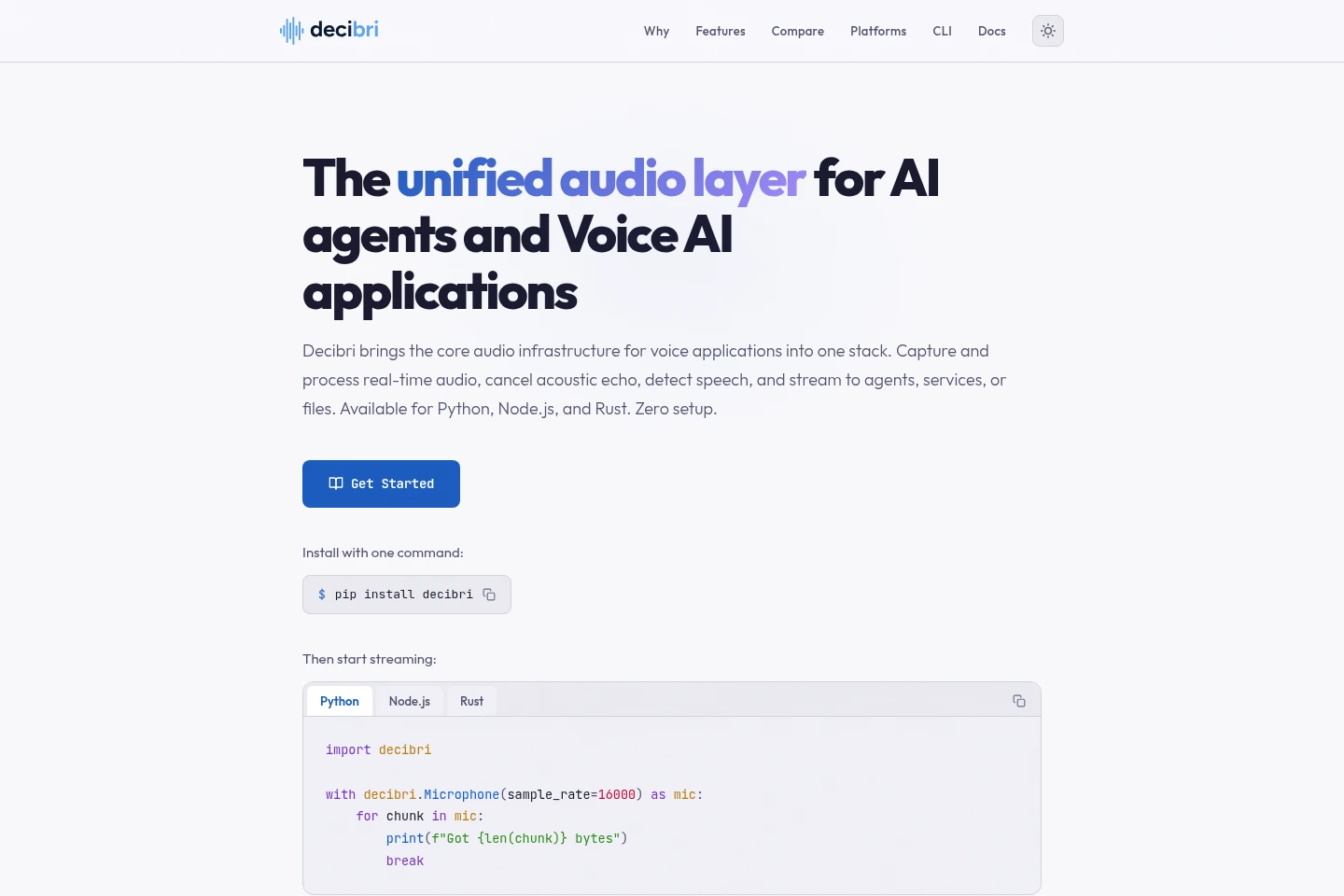
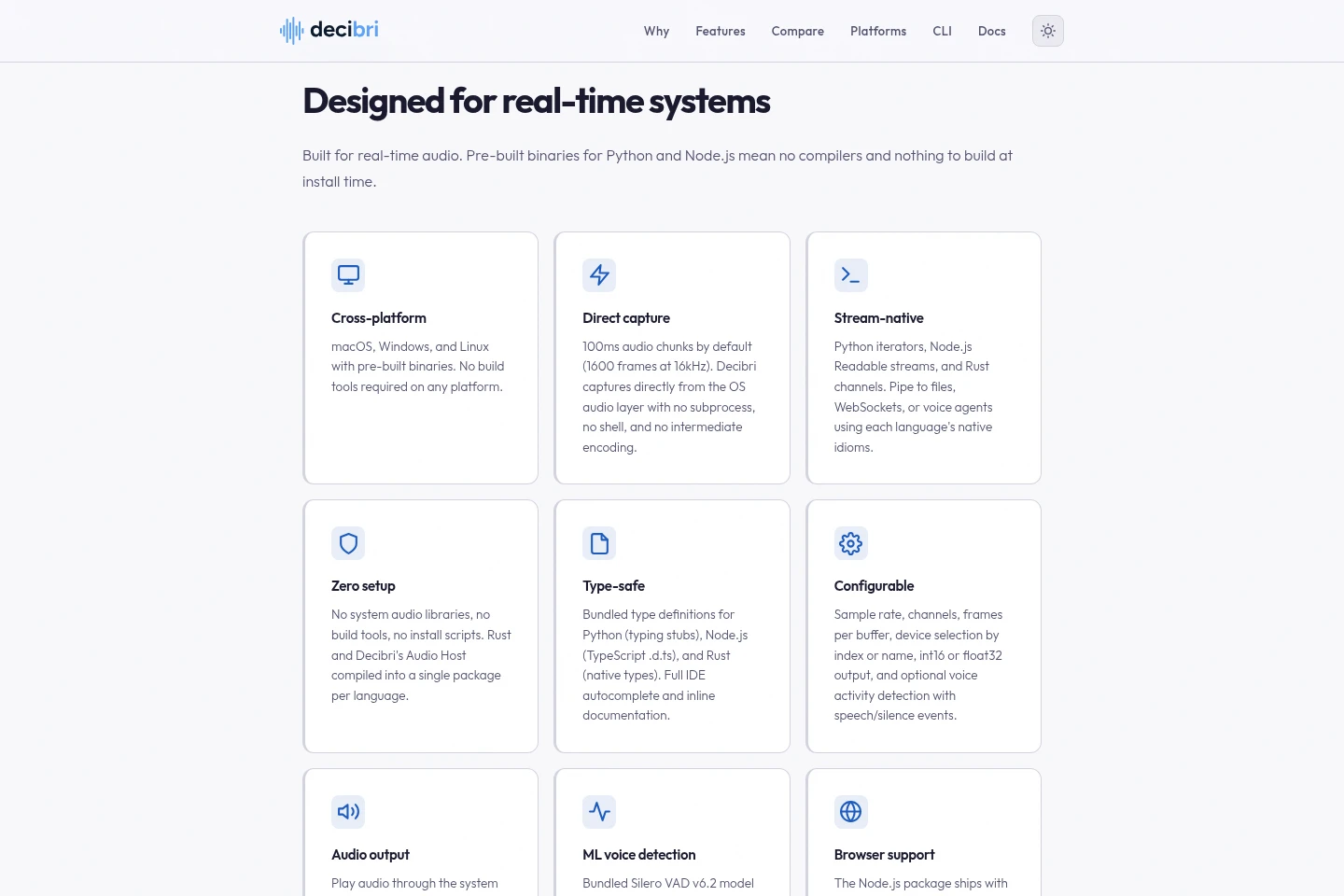
Captures microphone audio and outputs streamable audio chunks. Configure sample rate, channels, buffer frames, device selection, and int16 or float32 output; the default chunk is 100 ms.
System speaker playback
Plays audio through the operating system's speaker and accepts streamed audio as input. The Speaker API can be used as a write target alongside capture for full-duplex audio.
Local voice activity detection
Detects speech and silence and outputs voice activity events. The optional bundled Silero VAD v6.2 model runs locally in Rust through ONNX Runtime without requiring a cloud API.
Audio streaming and recording
Streams audio through Python iterators, Node.js Readable streams, or Rust channels, and can write recordings to files. Pipe the output to files, WebSockets, speech services, or voice agents.
Browser audio support
Provides browser audio capture through the Node.js package's AudioWorklet implementation. Conditional exports select the browser implementation when the package is bundled for a browser.
Audio Conditioning Engine (ACE)
Improve real-time and recorded audio with noise reduction, high-pass filtering, automatic gain control, and limiting. Processing runs locally without requiring cloud services.
Acoustic Echo Cancellation (AEC)
Reduce speaker echo captured by microphones during real-time voice interactions. Supports reference-based echo cancellation, double-talk awareness, and processing diagnostics.
Local and Cloud Speech Integrations
Connect real-time audio pipelines to local speech recognition and synthesis engines, or optional cloud speech-to-text providers. Supports offline, cloud-connected, and hybrid voice applications.
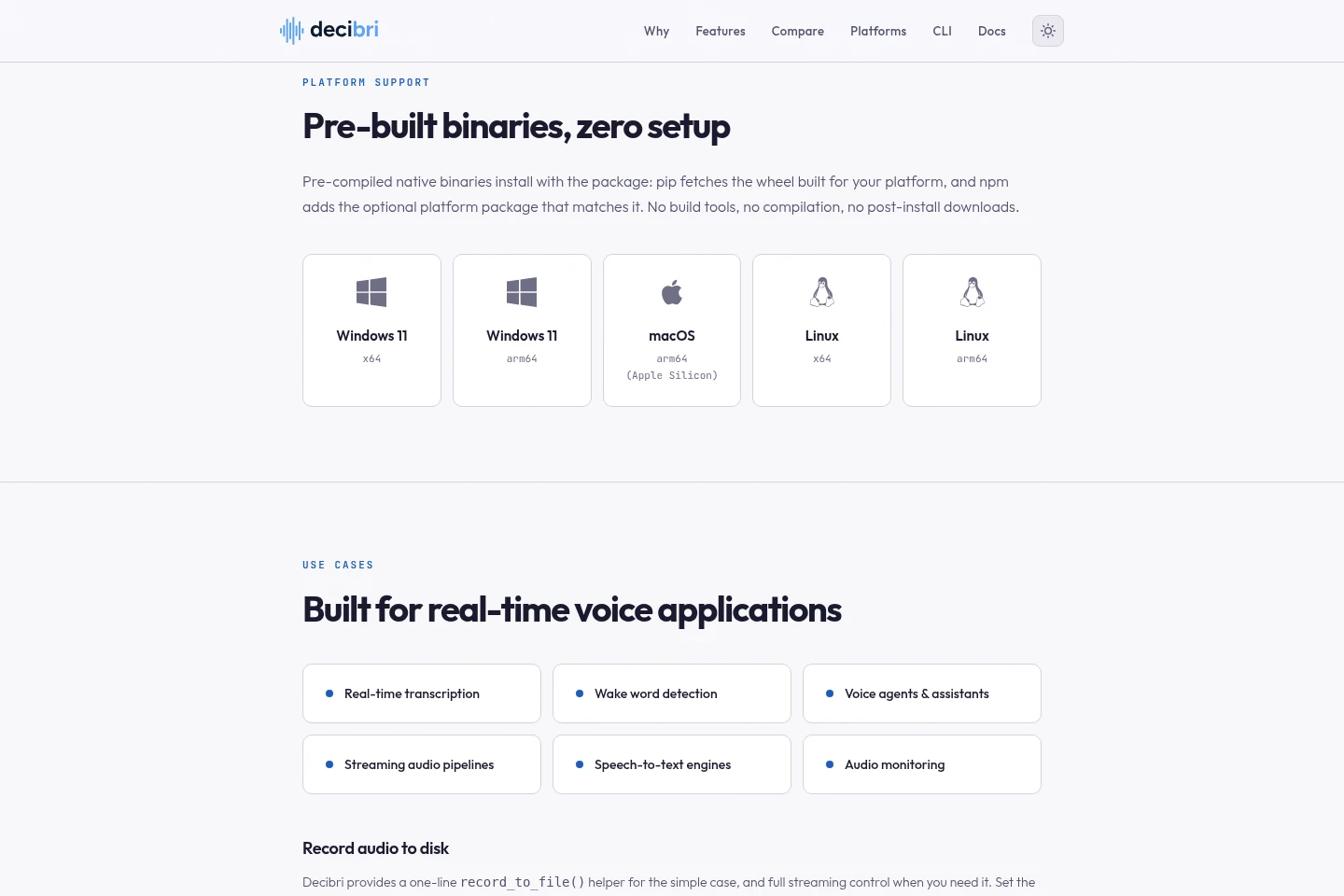
Build real-time audio and Voice AI applications with Python, Node.js, and Rust. Decibri provides consistent developer interfaces, native audio processing, and prebuilt binaries for supported platforms.













Comments